
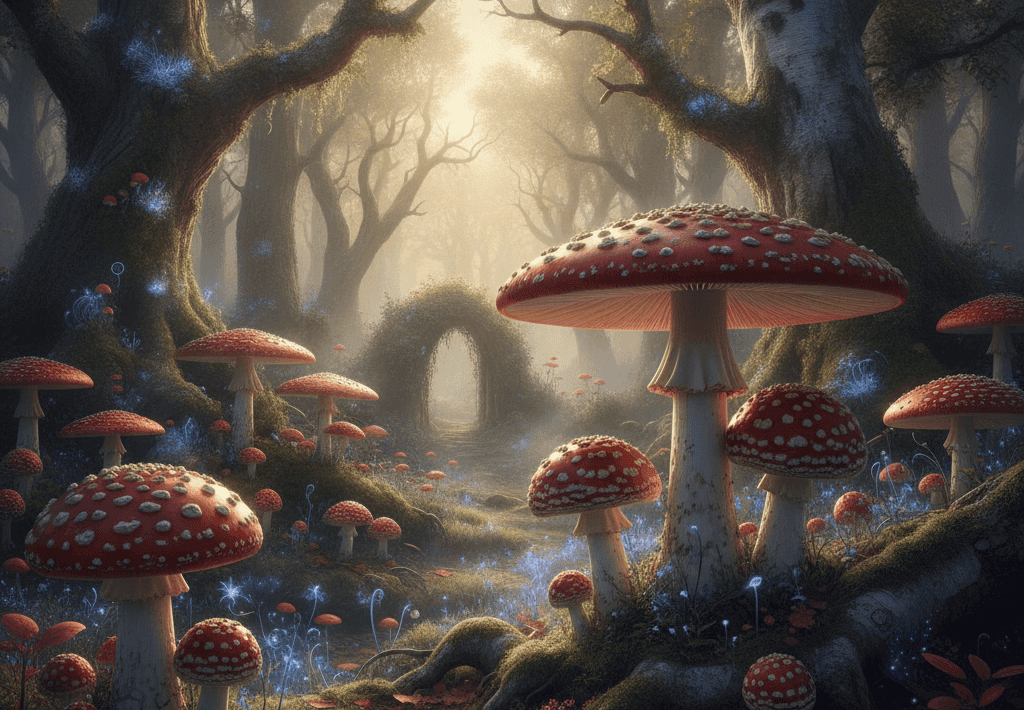
The forest floor holds many secrets, and among them is the striking fly agaric mushroom. I have always been fascinated by its vibrant appearance. This mushroom stands out with its bright red cap dotted with white flakes. It looks like something straight out of a fairy tale book.
For centuries, the fly agaric has captured human imagination. People tell many stories and traditions about it. This unique fungus holds a special place in folklore and culture around the world. We can learn a lot by exploring its natural characteristics and historical significance.
Today, I want to explore the real story behind this famous mushroom. I aim to uncover what makes it so distinct and why it continues to intrigue us. This journey helps us appreciate the natural world and its many wonders.
The Iconic Appearance of Fly Agaric Mushrooms
The fly agaric mushroom, known scientifically as Amanita muscaria, is one of the most recognizable fungi on Earth. Its signature look features a brilliant red or orange cap. These caps are usually adorned with white or yellowish wart-like spots. These spots are remnants of the universal veil that covered the young mushroom.
As the mushroom grows, its cap can flatten out. The white flakes sometimes wash off in the rain. Underneath the cap, you will find white gills. These gills are closely spaced and extend from the stem to the edge of the cap. The stem itself is thick and white. It has a distinctive skirt-like ring near the top. This ring is another piece of the universal veil.
The base of the stem often shows a bulbous swelling. This part is typically covered with concentric rings of scales. This feature is also a remnant of the veil. I find these details incredibly useful for identification. They help differentiate it from other less common mushrooms. Its beauty is truly something to behold in the wild.
Recognizing Its Key Features
When you encounter a fly agaric in its natural setting, you will notice certain things right away. The bright colors grab your attention first. The red can vary from deep scarlet to a lighter orange-red hue. The white flakes are generally consistent. They provide a beautiful contrast against the cap.
The cap size can range quite a bit. It is usually between 8 and 20 centimeters across. Young mushrooms often have a more rounded, almost spherical cap shape. As they mature, they spread out. The ring on the stem is persistent, meaning it stays there as the mushroom ages. This is an important detail for me to remember.
The scent of a fly agaric is mild. It is not something you would typically notice unless you held it up close. I have learned to appreciate these subtle identifiers. They are key to understanding this species. Finding one always feels like a special moment in the forest.
Ancient Roots and Cultural Stories of Amanita Muscaria
The fly agaric mushroom has a long and complex history with humans. People in various cultures have attributed mystical properties to it. Its distinctive look made it an obvious candidate for stories and rituals. I find these historical connections absolutely fascinating. They show how deeply nature influences our imagination.
In many northern European and Siberian traditions, this mushroom played a significant role. It was not simply a plant; it was often seen as a bridge between worlds. Some historical records suggest its use in shamanic practices. Shamans consumed the mushroom to achieve altered states of consciousness. This allowed them to communicate with spirits or gain insights.
These practices were often part of communal ceremonies. They held deep spiritual meaning for the participants. We can find many more fly agaric mushroom facts detailing its cultural importance. I believe understanding these past uses helps us appreciate its complex legacy. It is much more than just a pretty mushroom.
Myths Across Northern Cultures
The folklore surrounding fly agaric is rich and diverse. In Siberia, indigenous peoples like the Koryak and Chukchi used it ritualistically. They believed it allowed them to travel to spirit worlds. The mushroom was often consumed by shamans who then shared their visions. These visions guided their communities.
Some theories even suggest connections to the origins of Santa Claus imagery. The red and white colors resemble his suit. Reindeer are known to consume fly agaric. This could explain flying reindeer stories. These stories are a testament to how deeply ingrained this mushroom is in human culture. I enjoy thinking about how these ancient beliefs shaped our modern tales.
Symbolism in Fairy Tales
Beyond rituals, fly agaric also appears frequently in children’s literature and art. Its iconic shape and color make it a perfect subject for fantasy. We often see it depicted in illustrations of enchanted forests. It is a common feature in gnome and fairy gardens. This artistic presence contributes to its mystical reputation. It creates a sense of wonder for people of all ages.
I think its role in fairy tales shows our natural human attraction to things that look magical. Even if most people do not know its actual properties, the visual impact is strong. It reinforces the idea that nature holds hidden enchantments. This mushroom is a beautiful example of that.
Understanding the Active Compounds and Their Effects
The fly agaric contains psychoactive compounds, primarily muscimol and ibotenic acid. These are not classic psychedelics like psilocybin found in magic mushrooms. Instead, they interact with the brain in different ways. Ibotenic acid is a neurotoxin. It converts into muscimol when ingested or dried. Muscimol is the main psychoactive agent.
Muscimol acts as a GABA-A receptor agonist. This means it binds to GABA receptors in the brain. It mimics the effects of GABA, which is a calming neurotransmitter. The effects can vary widely from person to person. Factors like dosage, individual body chemistry, and preparation methods influence the experience.
Symptoms might include euphoria, disorientation, muscle twitching, and altered perception. Some users report vivid dreams or a feeling of detachment. It is important to know that consuming fly agaric can also cause nausea, vomiting, and dizziness. This makes it a risky substance to consume recreationally.
The Science Behind the Experience
Ibotenic acid can cause brain lesions if consumed in large quantities. This is why proper drying and preparation are crucial in traditional uses. The drying process helps to decarboxylate ibotenic acid into muscimol. This makes the mushroom less toxic and changes its effects. Raw fly agaric can be more dangerous. It delivers a higher concentration of ibotenic acid. I always advise extreme caution if anyone is considering interacting with this mushroom.
The effects are very different from psilocybin mushrooms. Psilocybin typically induces visual hallucinations and profound introspective experiences. Fly agaric effects are often described as more dreamlike or dissociative. They are not usually accompanied by strong visual changes. This distinction is important for accurate understanding. It shows that not all psychoactive mushrooms are alike.
The Importance of Proper Identification
Identifying the fly agaric mushroom correctly is very important. This is true whether you are a casual observer or a serious mushroom enthusiast. Misidentification can have severe consequences. Some other mushrooms look similar but are highly toxic. I always emphasize the need for careful observation when identifying any wild fungi.
One common look-alike is the Caesar’s mushroom, Amanita caesarea. This mushroom is edible and highly prized. However, it lacks the white flakes on its cap. It usually has a yellow stem and gills. It grows in different geographical areas. Knowing these subtle differences is key to staying safe. Never eat a wild mushroom unless you are 100% sure of its identity.
Another dangerous look-alike is the death cap, Amanita phalloides. While it does not look exactly like fly agaric, immature specimens could be confusing. The death cap is deadly. It has a greenish cap and no distinct spots. Its ring is usually skirt-like, and it has a volva, a cup-like structure at the base of the stem. I urge everyone to be incredibly careful.
Key Features for Identification
To identify fly agaric reliably, I look for several markers. The bright red cap with white, cottony warts is the first clue. The white gills that are free from the stem are another sign. I also check for the persistent white ring around the upper part of the stem. Finally, the bulbous base with its rings of scales helps confirm its identity. These features, when taken together, are very specific to fly agaric.
I also note the habitat. Fly agaric often grows near birch, pine, or spruce trees. It forms a symbiotic relationship with their roots. This environmental context provides an additional layer of certainty. I always recommend consulting multiple field guides. Speaking with experienced mycologists is also a wise choice. It ensures accuracy and safety.
Traditional Uses and Modern Misconceptions
Historically, the fly agaric was used by indigenous peoples in Siberia for spiritual purposes. Shamans consumed it to induce altered states. This allowed them to communicate with the spirit world. These were highly ritualized practices. They were passed down through generations. The knowledge of preparation and dosage was carefully guarded.
Today, many misconceptions surround this mushroom. Popular culture sometimes portrays it as a simple psychedelic. This idea is largely inaccurate. The experience it provides is distinct and often less predictable. It carries significant risks because of its toxicity. People sometimes think it is like other hallucinogenic mushrooms. This is a dangerous oversimplification.
I believe it is important to separate folklore from modern understanding. While its historical use is fascinating, it does not mean it is safe for casual consumption today. Modern science has given us a clearer picture of its chemical compounds. We understand its potential dangers better now. I always advocate for respect and caution when dealing with potent natural substances.
Ecological Role of Fly Agaric in Forest Ecosystems
Beyond its cultural significance, the fly agaric mushroom plays a vital role in forest health. It is a mycorrhizal fungus. This means it forms a symbiotic relationship with the roots of certain trees. This partnership is beneficial for both the mushroom and the tree. I often see it thriving in forests with specific tree species.
The fungus helps the tree absorb water and nutrients from the soil. It extends the tree’s root system effectively. In return, the tree provides the fungus with sugars produced during photosynthesis. This exchange is a cornerstone of forest ecology. It supports the growth and resilience of the trees. Without such fungi, many trees would struggle to survive.
Fly agaric is commonly found growing with birch, pine, spruce, and fir trees. Its presence indicates a healthy forest ecosystem. I enjoy observing these relationships in nature. It reminds me how interconnected everything is. The mushroom is a sign of a vibrant and balanced environment.
Supporting Forest Health
The fungus forms a network of fine threads called mycelium in the soil. This network connects to the tree roots. It acts like an extension of the tree’s own absorption system. This boosts the tree’s ability to take in essential minerals. It also provides some protection against pathogens. The mycelial network is usually vast and hidden underground.
The fruiting body, which is the visible mushroom, is just a small part of this larger organism. The true work of the fungus happens beneath the surface. This underground partnership is crucial for the long-term health of many forests. I always feel a deeper connection to nature when I understand these ecological details.
Respecting Nature’s Gifts and Dangers
My exploration of the fly agaric mushroom has always centered on respect. This mushroom is a beautiful part of nature. It holds deep cultural and ecological value. However, it also demands caution. Its toxic properties mean it should never be consumed without expert knowledge. I always encourage people to appreciate it from a distance.
Learning about its history and biology enhances our appreciation for the natural world. We can admire its striking appearance. We can understand its role in forest ecosystems. There is so much to gain from observing nature. We do not need to consume everything we find to appreciate it fully.
Responsible interaction with wild fungi means prioritizing safety. It means educating ourselves about different species. It also means leaving mushrooms undisturbed for others to enjoy. This approach helps preserve these natural wonders for future generations. I believe this respect is fundamental to enjoying the outdoors.
Conclusion: Embracing the Mystery of Fly Agaric
The fly agaric mushroom, with its stunning red cap and white flakes, is truly a symbol of nature’s mysteries. We have walked through its iconic appearance and its deep roots in ancient cultures. We have seen how it inspired shamans and fairy tales alike. Understanding its active compounds and their specific effects helps us approach it with informed caution. This is important because its beauty belies its toxic nature. We also recognize its vital ecological role, forming crucial symbiotic relationships that underpin healthy forest ecosystems. It is not just a pretty face; it is an active participant in nature’s grand design. I always emphasize that proper identification is a serious matter. It helps prevent accidental harm from look-alike species. Our journey into the world of this mushroom underscores a simple truth: nature is full of wonders. It offers beauty, history, and intricate biological processes. We should appreciate these natural gifts responsibly. I encourage everyone to learn more about the fungi in their local environments. Go out and observe the natural world around you. You might discover something equally fascinating and beautiful.